Table of Contents
How Deserts Form and Evolve: The Science Behind Earth’s Driest Places
Deserts cover nearly one-third of Earth’s land surface, yet they remain among the most misunderstood ecosystems on our planet. Far from being lifeless wastelands, deserts are dynamic environments shaped by intricate interactions between climate, geography, and geological time. From the towering dunes of the Sahara to the frozen expanses of Antarctica, understanding how deserts form reveals fundamental truths about Earth’s climate systems and the remarkable adaptability of life itself.
Whether you’re curious about desert formation processes, wondering why certain regions become deserts, or seeking to understand the science of desertification, this comprehensive guide explores the mechanisms that create and transform these fascinating landscapes.
What Defines a Desert?
The common misconception that deserts are simply sandy, hot places couldn’t be further from the truth. Deserts are defined by aridity—the profound lack of available moisture—rather than temperature or terrain.
To qualify as a desert, a region typically receives less than 10 inches (250 millimeters) of precipitation annually. Some deserts receive far less—the Atacama Desert in Chile has areas that haven’t seen measurable rainfall in decades. This extreme water scarcity shapes every aspect of the desert environment, from soil composition and vegetation patterns to the remarkable survival strategies employed by desert-dwelling organisms.
The evaporation rate in deserts often exceeds precipitation, creating a moisture deficit that prevents most plants from establishing roots. This explains why deserts can exist across a stunning range of temperatures—from the scorching 134°F (56.7°C) recorded in Death Valley to the bone-chilling -128.6°F (-89.2°C) measured in Antarctica.
Beyond Temperature: Understanding Aridity
Aridity isn’t just about rainfall amounts—it’s about the balance between precipitation and evapotranspiration (water lost through evaporation and plant transpiration). In hot deserts, intense solar radiation causes rapid evaporation, while in cold deserts, water becomes locked in ice, making it biologically unavailable. Both scenarios create the fundamental water stress that defines desert ecosystems.
The Main Types of Deserts
Desert classification reveals the diverse mechanisms behind their formation. Each type emerges from distinct climatic and geographic conditions, producing vastly different landscapes and ecosystems.
1. Hot and Dry Deserts (Subtropical Deserts)
These are the quintessential deserts that populate our imagination—sweltering daytime temperatures, minimal vegetation, and landscapes dominated by sand dunes, rocky plateaus, or bare soil. Hot deserts experience extreme temperature fluctuations, with daytime highs exceeding 100°F (38°C) while nighttime temperatures can plummet by 40-50 degrees.
Examples:
- Sahara Desert (Africa): Spanning 3.6 million square miles, it’s the world’s largest hot desert
- Arabian Desert (Middle East): Home to the iconic Rub’ al Khali, or “Empty Quarter”
- Sonoran Desert (North America): Known for its diverse cacti, including the towering saguaro
2. Cold Deserts (Temperate and Polar Deserts)
Cold deserts experience freezing temperatures for much of the year, with precipitation often falling as snow rather than rain. These environments challenge our preconceptions about what deserts look like, yet they meet the fundamental criterion of extreme aridity.
Examples:
- Gobi Desert (Asia): Experiences temperature extremes from -40°F to 122°F (-40°C to 50°C)
- Great Basin Desert (USA): North America’s largest cold desert, characterized by sagebrush plains
- Antarctic Desert: The world’s largest desert overall, receiving less than 2 inches of precipitation annually
The Antarctic Desert demonstrates that extreme cold can create aridity as effectively as heat—when water is permanently frozen, it becomes unavailable to life, creating desert conditions despite being covered in ice.
3. Coastal Deserts
These unique deserts form along continental margins where cold ocean currents create paradoxical conditions—high humidity but virtually no rainfall. The cold water chills the air above it, preventing the warm temperatures needed for precipitation while creating frequent fog that provides minimal moisture to specialized plants.
Examples:
- Atacama Desert (Chile): The driest non-polar desert, with some weather stations never recording rainfall
- Namib Desert (Namibia): Ancient desert where fog-harvesting beetles have evolved remarkable adaptations
4. Rain Shadow Deserts
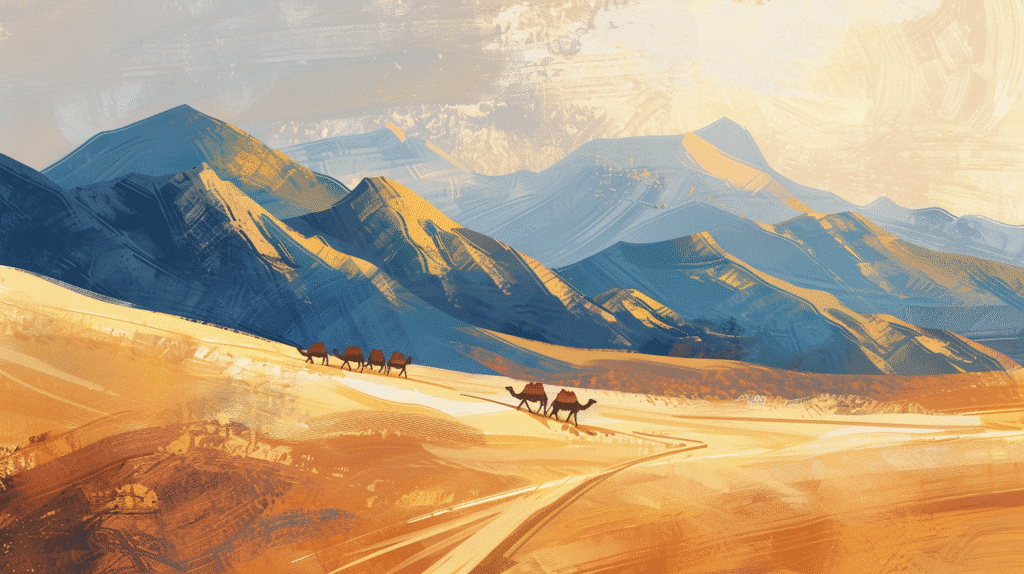
These deserts form on the leeward side of mountain ranges through a process called the rain shadow effect. As moisture-laden air rises over mountains, it cools and releases precipitation on the windward slopes. By the time this air descends on the opposite side, it has lost most of its moisture and warms as it descends, creating extremely dry conditions.
Examples:
- Mojave Desert (United States): Created by the Sierra Nevada rain shadow
- Patagonian Desert (Argentina): Formed in the rain shadow of the Andes Mountains
How Deserts Form: The Key Processes Behind Arid Landscapes
Understanding desert formation mechanisms requires examining both atmospheric circulation patterns and geographic factors. Deserts don’t appear randomly—they emerge in predictable locations based on fundamental principles of Earth’s climate system.
1. Subtropical High-Pressure Systems and Hadley Cells
The most widespread desert formation process involves global atmospheric circulation patterns. Around 30° north and south of the equator, hot air that rose at the equator descends back toward Earth’s surface. As this air descends, it compresses and warms, increasing its capacity to hold moisture without releasing it as precipitation.
This creates persistent high-pressure zones called subtropical highs, characterized by clear skies, intense solar radiation, and extremely low rainfall. This single mechanism explains the existence of the world’s greatest hot deserts:
- Sahara Desert (North Africa)
- Kalahari Desert (Southern Africa)
- Australian Outback
- Arabian Desert (Middle East)
- Sonoran and Chihuahuan Deserts (North America)
The regularity of these pressure systems means that subtropical deserts are remarkably stable over geological timescales, though climate change is now disrupting these long-established patterns.
2. The Rain Shadow Effect: Mountains as Moisture Barriers
When moist air masses encounter mountain ranges, they’re forced upward. As air rises, it expands and cools, eventually reaching its dew point—the temperature at which water vapor condenses into clouds and precipitation. This process, called orographic lifting, dumps abundant rainfall on windward mountain slopes.
However, once air crosses the mountain crest and descends on the leeward side, it undergoes adiabatic warming—it heats up as it descends and compresses, greatly increasing its capacity to hold moisture without releasing precipitation. The result is a rain shadow desert, often located remarkably close to lush, rain-soaked mountains.
The Cascade Range in the Pacific Northwest demonstrates this dramatically: the western slopes receive over 100 inches of rain annually, while just 50 miles east, semi-arid conditions prevail with less than 10 inches.
3. Cold Ocean Currents: Coastal Desertification
Some of Earth’s driest deserts form where cold ocean currents flow along continental margins. Cold water has a profound effect on coastal climates—it chills the air above it, creating a stable temperature inversion that prevents the vertical air movement necessary for cloud formation and precipitation.
The Atacama Desert exemplifies this process. The cold Humboldt Current (also called the Peru Current) flows northward along the Chilean coast, creating one of the most extreme examples of coastal desert formation. Some meteorological stations in the Atacama have never recorded measurable rainfall, making portions of this desert the driest places on Earth outside of polar regions.
Interestingly, these coastal deserts often experience frequent fog and low clouds despite receiving no rain—the cold ocean water creates condensation that never develops into precipitation.
4. Continental Interior Effect: Distance from Moisture Sources
The further inland you travel from oceans and large water bodies, the less moisture air masses contain. By the time maritime air penetrates deep into continental interiors, it has lost most of its moisture to precipitation along the way.
The Gobi Desert in central Asia illustrates this principle perfectly. Located thousands of miles from the nearest ocean, it receives minimal moisture from distant maritime sources. Additionally, surrounding mountain ranges block moisture-bearing winds, compounding the aridity.
This continentality effect explains why the largest landmasses—Asia, Africa, and Australia—contain extensive interior deserts, while smaller landmasses and islands rarely develop true desert conditions.
5. Human-Induced Desertification: Accelerating Natural Processes
While most deserts form through natural climatic and geographic processes, human activities can dramatically accelerate desertification or create desert-like conditions in previously productive lands. This process, called anthropogenic desertification, represents one of the most serious environmental challenges facing vulnerable regions.
Key human activities that contribute to desertification include:
Overgrazing: When livestock populations exceed the land’s carrying capacity, vegetation is stripped faster than it can regenerate, exposing soil to erosion and preventing water retention.
Deforestation: Removing trees and shrubs disrupts the water cycle, reduces soil stability, and eliminates the shade that helps retain soil moisture.
Unsustainable Agriculture: Poor irrigation practices can lead to soil salinization, while intensive farming depletes soil nutrients and structure, making land increasingly unproductive.
Climate Change: Rising global temperatures are shifting precipitation patterns, expanding existing deserts and creating new arid zones. The Intergovernmental Panel on Climate Change warns that desertification will accelerate as the planet warms, particularly affecting semi-arid regions already on the edge of viability.
The Sahel region of Africa, bordering the southern Sahara, demonstrates how human pressure can interact with natural climate variability to expand desert boundaries. While the Sahara naturally fluctuates in size over centuries, overgrazing and deforestation have accelerated desertification in vulnerable border zones.
How Deserts Evolve: Dynamic Landscapes in Constant Motion
Far from being static wastelands, deserts are among Earth’s most geologically active environments. The very factors that create deserts—aridity, temperature extremes, and minimal vegetation—also drive continuous landscape transformation.
Wind Erosion and Aeolian Processes
In the absence of protective vegetation, wind becomes the dominant sculptural force in desert landscapes. Desert winds carry sand and dust particles that act as natural sandblasters, gradually wearing away exposed rock surfaces through a process called abrasion.
Aeolian erosion (wind-driven erosion) creates distinctive desert landforms:
- Ventifacts: Rocks polished and faceted by wind-blown sand
- Yardangs: Streamlined ridges carved parallel to prevailing winds
- Desert pavements: Surfaces of tightly packed stones left behind after wind removes finer particles
- Deflation hollows: Depressions formed where wind removes loose material
The rate of wind erosion in deserts can exceed water erosion by orders of magnitude, particularly in areas with sparse vegetation and abundant loose sediment.
Sand Dune Formation and Migration
Perhaps the most iconic desert features, sand dunes represent accumulations of wind-transported sediment. Contrary to popular belief, only about 20% of desert surfaces are covered by sand dunes—most deserts consist of rocky plateaus or gravel plains.
Dunes form when wind-blown sand accumulates around obstacles or in areas where wind velocity decreases. Once established, dunes migrate downwind as sand particles climb the windward slope and cascade down the leeward slope in a process called saltation.
Different dune types reflect varying wind patterns:
- Barchan dunes: Crescent-shaped dunes formed by unidirectional winds
- Longitudinal (seif) dunes: Long, parallel ridges aligned with prevailing winds
- Star dunes: Multi-armed dunes created by winds from multiple directions
- Transverse dunes: Wave-like ridges perpendicular to wind direction
Large dunes can migrate 30-100 feet (10-30 meters) annually, gradually reshaping the desert landscape. In some regions, ancient dune fields have been stabilized by vegetation or climate changes, preserving snapshots of past desert conditions.
Flash Flooding: The Power of Rare Desert Rains
When precipitation does occur in deserts, it often arrives as intense, localized storms that can deliver months’ worth of rain in hours. The hard-packed, impermeable desert soil cannot absorb water quickly, causing rapid runoff that concentrates in dry riverbeds called wadis (in the Middle East and North Africa) or arroyos (in the Americas).
These flash floods are powerful agents of erosion and landscape change:
- They carve deep channels through alluvial deposits
- They transport enormous volumes of sediment, sometimes traveling dozens of miles
- They create temporary oases that can last days or weeks
- They deposit sediment in alluvial fans at canyon mouths
The erosive power of flash floods is remarkable—a single flood event can accomplish more geological work than decades of gradual wind erosion. Desert canyons, despite their arid setting, are primarily water-carved features.
Long-Term Climate Oscillations and Desert Expansion
Over geological timescales, deserts dramatically expand, contract, and even shift locations in response to climate changes. Evidence from lake bed sediments, ancient vegetation patterns, and archaeological sites reveals that today’s deserts were often very different in the recent past.
The Sahara Desert has oscillated between hyperarid desert and relatively green savanna multiple times over the past 10,000 years, driven by cyclic changes in Earth’s orbit called Milankovitch cycles. During “Green Sahara” periods (the most recent ending about 5,000 years ago), the region supported lakes, rivers, grasslands, and diverse wildlife.
Similarly, the American Southwest was significantly wetter during the last Ice Age, with now-dry lake beds marking the locations of ancient bodies of water like Lake Bonneville (which covered much of Utah) and numerous smaller pluvial lakes.
Climate models predict that anthropogenic climate change will cause some deserts to expand while potentially bringing more moisture to others, fundamentally altering these landscapes over the coming centuries.
Life in the Desert: Remarkable Adaptations to Extreme Aridity
Despite seemingly inhospitable conditions, deserts support surprisingly diverse ecosystems. The organisms that thrive in these environments have evolved extraordinary adaptations to cope with water scarcity, temperature extremes, and intense solar radiation.
Plant Adaptations: Masters of Water Conservation
Desert plants, called xerophytes, employ multiple strategies to survive with minimal water:
Succulence: Plants like cacti and agaves store water in thick, fleshy tissues, allowing them to survive months without rain. Some cacti can absorb hundreds of gallons of water during a single rainfall event.
Reduced Leaf Surface: Many desert plants have tiny leaves or no leaves at all, minimizing water loss through transpiration. Ocotillo and palo verde trees demonstrate this adaptation.
Deep Root Systems: Some desert plants, like mesquite trees, send roots down 100 feet or more to access deep groundwater.
Dormancy: Annual wildflowers remain as seeds during dry periods, germinating rapidly after rare rains to complete their entire life cycle in weeks.
CAM Photosynthesis: Many desert plants use Crassulacean Acid Metabolism, opening their stomata only at night to reduce water loss while still performing photosynthesis.
The creosote bush of North American deserts can live for thousands of years, with individual clones surviving up to 11,000 years—making them among Earth’s oldest living organisms.
Animal Adaptations: Thriving Without Abundant Water
Desert animals have evolved equally impressive strategies to cope with water scarcity:
Nocturnal Behavior: Most desert animals, from kangaroo rats to sidewinder rattlesnakes, are active during cooler nighttime hours, avoiding daytime heat stress.
Metabolic Water Production: Kangaroo rats never drink water—they produce all the moisture they need through metabolic breakdown of dry seeds.
Efficient Kidneys: Desert animals produce highly concentrated urine to minimize water loss. Camels’ urine is thick as syrup.
Heat Tolerance: Camels can allow their body temperature to rise during the day and drop at night, reducing the need for evaporative cooling.
Specialized Anatomy: Large ears on fennec foxes and kit foxes radiate heat. Pale coloration reflects solar radiation.
Estivation: Some desert animals, like the desert tortoise, enter a dormant state during the hottest months, similar to hibernation.
These adaptations represent millions of years of evolutionary refinement, showcasing life’s remarkable ability to exploit even the most challenging environments.
Famous Deserts of the World: A Global Perspective
Understanding specific deserts helps illustrate the diverse processes behind desert formation and evolution:
| Desert | Location | Type | Notable Features | Annual Precipitation |
|---|---|---|---|---|
| Sahara | North Africa | Hot & Dry (Subtropical) | World’s largest hot desert; spans 11 countries | <4 inches |
| Arabian | Middle East | Hot & Dry (Subtropical) | Contains Rub’ al Khali, one of the largest sand seas | <4 inches |
| Gobi | Mongolia/China | Cold Desert | Extreme temperature range; expanding due to desertification | 2-8 inches |
| Atacama | Chile | Coastal Desert | Driest non-polar desert; some areas have never recorded rain | <0.6 inches |
| Antarctic | Antarctica | Polar Desert | Largest desert overall; 98% ice-covered | <2 inches |
| Namib | Namibia | Coastal Desert | Oldest desert on Earth; famous fog and unique adaptations | <0.5 inches |
| Sonoran | USA/Mexico | Hot & Dry (Subtropical) | Most biodiverse desert; iconic saguaro cacti | 3-15 inches |
| Kalahari | Southern Africa | Hot & Dry (Semi-arid) | Actually a semi-arid savanna in many areas | 5-10 inches |
| Patagonian | Argentina | Rain Shadow | Created by Andes Mountains; supports unique wildlife | 7 inches |
| Mojave | USA | Rain Shadow | Home to Death Valley, hottest place on Earth | <5 inches |
Each desert tells a unique story about the interplay between climate, geography, and time in creating Earth’s arid zones.
Why Deserts Matter: Essential Roles in Earth’s Systems
Far from being empty wastelands, deserts perform critical functions in maintaining planetary health and supporting human civilization.
Climate Regulation and Global Nutrient Cycling
Desert dust plays a surprising role in global ecology. Every year, hundreds of millions of tons of Saharan dust are transported across the Atlantic Ocean, where it:
- Fertilizes Amazon rainforest soils with phosphorus and other minerals
- Provides iron to oceanic phytoplankton, supporting marine food webs
- Influences cloud formation and precipitation patterns
- Affects hurricane development in the Atlantic
This transcontinental nutrient transport demonstrates the interconnectedness of Earth’s ecosystems—the health of tropical rainforests depends partly on dust from thousands of miles away.
Biodiversity Hotspots and Evolutionary Laboratories
Despite harsh conditions, many deserts are biodiversity hotspots containing species found nowhere else on Earth. The specialized adaptations required for desert survival have driven remarkable evolutionary innovations.
The Sonoran Desert alone supports over 2,000 plant species, 500 bird species, and numerous endemic reptiles and mammals. Many modern drought-resistant crops and medicines have been developed from desert plants.
Cultural Heritage and Human History
Deserts have been home to human cultures for millennia, shaping unique ways of life adapted to arid conditions:
- Ancient trade routes like the Silk Road crossed Asian deserts, connecting civilizations
- Nomadic peoples like the Bedouin and Tuareg developed sophisticated desert survival strategies
- Desert oases supported early agricultural civilizations
- Indigenous peoples of the Australian Outback and American Southwest developed deep ecological knowledge
Archaeological sites in deserts often preserve remarkably well due to extreme aridity, providing windows into human history.
Economic Resources
Deserts contain valuable natural resources:
- Mineral deposits: Many deserts harbor copper, gold, lithium, and rare earth elements
- Solar energy potential: Intense sunlight makes deserts ideal for solar power generation
- Petroleum reserves: Many oil and gas fields lie beneath desert surfaces
- Tourism: Desert landscapes attract millions of visitors annually
As renewable energy becomes increasingly important, the solar potential of deserts may prove critical in addressing climate change.
The Future of Deserts: Challenges and Conservation
Understanding how deserts form is increasingly important as climate change threatens to expand arid zones into currently productive lands. The United Nations estimates that desertification affects the livelihoods of over 250 million people and threatens approximately one billion more in vulnerable dryland regions.
Climate Change Impacts
Warming temperatures are altering desert boundaries:
- Some subtropical deserts are expanding poleward
- Changed precipitation patterns are creating new arid zones
- Increased evaporation is intensifying existing deserts
- More frequent droughts are pushing semi-arid regions toward desert conditions
Conservation and Sustainable Use
Protecting and sustainably managing desert ecosystems requires:
- Combating desertification through sustainable land management
- Protecting native desert species and habitats
- Supporting traditional desert cultures and knowledge
- Developing drought-resistant agriculture and water conservation
- Balancing resource extraction with ecosystem protection
The challenge lies in valuing deserts not as empty spaces awaiting development, but as complex, valuable ecosystems deserving protection and respect.
Final Thoughts: The Dynamic Nature of Earth’s Arid Lands
Deserts are far more than endless stretches of sand—they are living laboratories showcasing evolution, geological transformation, and environmental resilience. The processes that form deserts—from global atmospheric circulation to mountain rain shadows—reveal fundamental principles of Earth’s climate system.
Understanding how deserts form and evolve helps us appreciate not only their stark beauty but also their critical role in planetary function. As climate change accelerates, this knowledge becomes increasingly vital for predicting how these landscapes will transform and how we can protect vulnerable regions from desertification.
Whether carved by wind, shaped by ancient floods, or transformed by shifting climates over millennia, deserts remind us that Earth’s landscapes are never truly static. They challenge our assumptions about where and how life can thrive, and they stand as testament to the power of adaptation and the delicate balance that sustains our planet’s diverse ecosystems.